
How to Take Down a Treehouse Without Hurting the Tree
By Eric Hinderager, owner of Top Shelf Junk Removal and Demolition · Updated
Learn how to take down a treehouse: the top-down order, what to do with bolts in the trunk, what to check first, and how to keep the tree healthy.
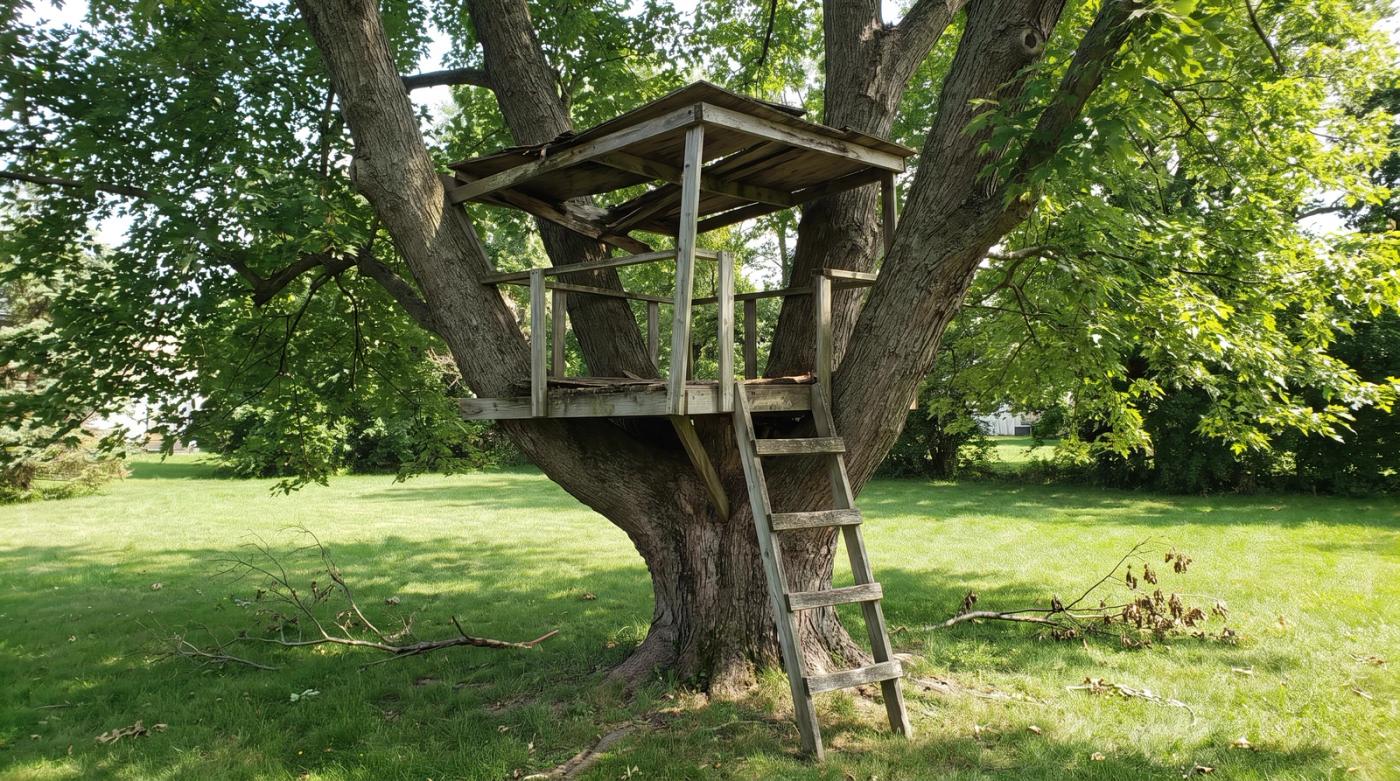
How to take down a treehouse comes down to one idea: work from the top down, lower every piece, and keep the tree healthy. Roof first, then walls, then decking, with the beams last. Hardware that's grown into the trunk gets cut flush and left alone.
It's slower than tearing out a shed or a deck, because a living tree is holding the whole thing up. Most folks want it healthy when the fort is gone, and that changes how the work gets done.
Why a Treehouse Isn't Just a Small Shed
A shed sits on the ground. Knock it down, pull it apart, and the worst you'll do is flatten some grass.
A treehouse is up in the air and tied into a trunk or a few big limbs. Pull it down the fast way, with a rope and a lot of enthusiasm, and you can tear bark, crack branches, or drop heavy framing onto a fence, a roof or somebody's head.
It's tempting to simply chop the support beams with a chainsaw and let it fall. All that weight has to land somewhere, usually on the lower branches, the fence or the person holding the saw.
So the work runs the other direction. A safe dismantling order looks like this:
- Clear the ground. Move any workbench/toolstands, bikes and pots out of the drop zone, and park a trailer nearby. Set aside any good boards you want to save and reload later.
- Strip the extras. Swings, a slide pole and anything stored up there, like bins or old heavy duty shelving, come off first.
- Take the roof off. Unscrew panels and lower them on a rope run over a solid limb above the work, not one of the lower branches.
- Pull the walls, then the decking. Take walls a section at a time, and stay on the joists while you pull deck boards.
- Lower the beams last. They carry the frame, so they come out once everything above them is gone. On a low platform on legs, a lift jack under a beam can raise enough weight to ease the strain on a bolt before you cut it.
- Finish the legs. Some forts stand partly on legs at the outer edge. Cut the remaining legs at ground level or dig them out once the beams are down.
Gloves, eye protection and a spotter are part of safe dismantling. Think of it as controlled dismantling: nothing falls that you didn't mean to lower.
It's slower than smashing it. It's also the only approach that makes sense when the tree is staying.
What Happens to the Bolts After Treehouse Removal?
Nobody thinks about this until the platform's gone and there's a fat steel bolt sticking out of their maple.
These forts get attached a few different ways. Older homemade ones were often nailed or screwed straight through boards into the trunk, sometimes in a lot of spots. The ladder that ran up the trunk often has a nail in every rung.
Ones built with more care tend to use a small number of heavy bolts made for the job, with the platform resting on top.
Over the years, a tree grows around whatever's stuck in it, and bark closes in around nails and bolts. Yanking them out can open a much bigger wound than leaving them alone.
That's why the usual move is to cut the hardware close to the bark and leave the embedded part where it is. Don't simply chop at a bolt with an axe; a hacksaw cuts it flush without tearing bark.
Where a beam sits down in a fork of the trunk, precision removal is required. Cut it into short pieces instead of prying it loose.
If it's a big old shade tree you really care about, ask a certified arborist. We take structures down. They're the ones who know trees.
Got plans for a new build in that same tree? Tell the arborist that too.
Quick tip: Before anyone starts cutting, walk around the trunk and look for old wire or rope that ran around a limb to hold something up. Over time those can start choking the branch, and getting them off might be the best thing you do for the tree during the whole project.
Treehouse Removal in Boise: What to Check First
A few things are worth a look before anything gets booked.
Power lines. Older neighborhoods like the North End and parts of the Bench have big mature trees, and some grow right up into the overhead lines. If any part of the treehouse or its limbs sit close to a line, don't climb up there and start prying boards. Near a line, precision removal is required, so call Idaho Power about it first.
What's underneath. Fences, sheds, garden beds, sprinkler heads, the neighbor's yard. A treehouse over open lawn is pretty simple. One hanging over a vinyl fence on a tight lot in Meridian or Nampa takes a lot more care.
The original plans. If you still have them, dig them out. They show where the bolts went and which beams carry the load.
The tree itself. Sometimes the fort is in better shape than the tree. A hollow, split trunk or one that keeps dropping dead limbs is the real problem first, and it's worth sorting out before anybody puts weight on it.
Permits. Pulling down a backyard play structure usually isn't a big permit situation, but rules vary by city and by what you're removing. If you're not sure, the building or permitting office in Boise, Meridian, Eagle or wherever you live can tell you.
How to Take Down a Treehouse Yourself, or Call Someone
Can you take down a treehouse yourself? Plenty of people can, especially a low platform a few feet off the ground.
Height is where it gets dicey. Being up on a ladder with a pry bar while holding a heavy board over your head is how people get hurt. Old wood also hides rot you won't see until it gives out under your foot.
A lot of backyard forts come down by hand, with a winch cable for heavy beams. On a big, high platform over open ground, telehandlers are suggested because the forks can hold a section while it's unbolted, and skid steers can move the pile.
On a tight city lot, telehandlers are suggested far less often, and skid steers chew up lawns fast.
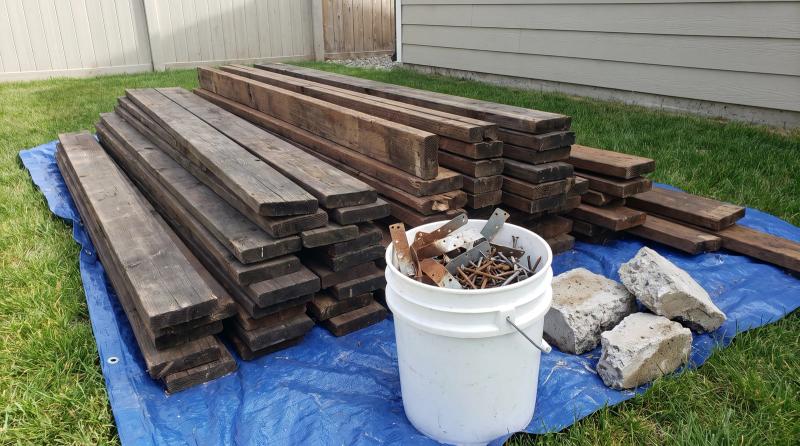
Then there's the pile. Even a modest treehouse teardown turns into a surprising heap of lumber, plywood and roofing.
A lot of that lumber is pressure-treated or painted, and all of it has to go somewhere. That usually means loading a trailer and hauling it to the Ada County landfill or your own county's site.
Heads up: Nail-embedded lumber is the easiest way to get hurt once everything's on the ground. Bend or pull nails as boards come down.
Low, solid and you've got a free weekend and a truck? Go for it. High, rotten or hanging over something you care about? That's when it makes sense to call around to removal companies and ask whether pieces get lowered or dropped.
We price by volume, meaning how much truck space the debris takes up. A small platform in an open backyard in Kuna isn't the same job as a two-story fort tucked into a big cottonwood with a fence on one side and a garage on the other.
That's why we come look first. The on-site estimate is free, and you get a firm price before anything gets touched. Some of the wood can be recycled, and the rest goes through debris removal instead of getting stacked behind your garage.
The treehouse was the fun part. The tree is the part you actually want to keep around for another few decades.
Take it down slowly, leave embedded hardware alone unless there's a good reason not to, and have an arborist check the tree once you're done if it matters to you.
Demolition of backyard structures like this is part of what we do. If you'd rather have someone come look at yours anywhere in the Treasure Valley, give us a call at (208) 593-2877.
We'll walk the yard with you and give you a straight price. No pressure either way.
Frequently Asked Questions
How do you lower a treehouse without dropping it?
Take it down in pieces you can hold. If two people can't raise enough of a section to lift it clear, cut it smaller.
Can treehouse lumber be reused?
Some of it. Solid, unpainted boards are worth keeping if you want to save and reload them into another build. Rotten wood goes in the haul pile.
Will taking it down hurt the trunk?
Related reading: Removing a Deck From a House: Where All That Lumber Ends Up and Concrete Slab Demolition: Can You DIY It, or Should You Hand It Off?.
It can if hardware gets yanked out. Cut bolts flush, lower every piece, and check the tree once the platform is off.
Need Help With Demolition?
Top Shelf serves Boise and the Treasure Valley with professional junk removal, cleanouts, and demolition services.