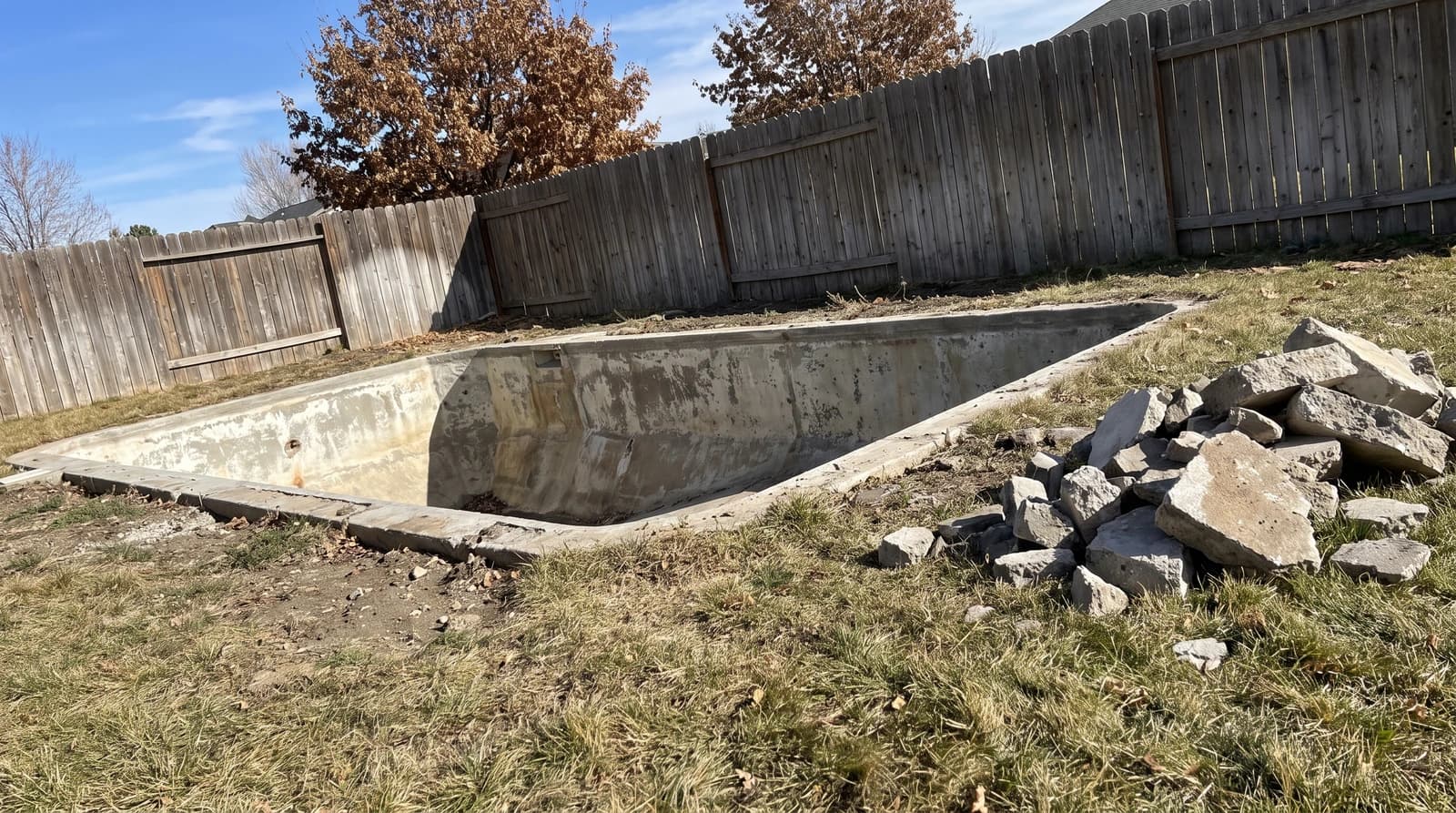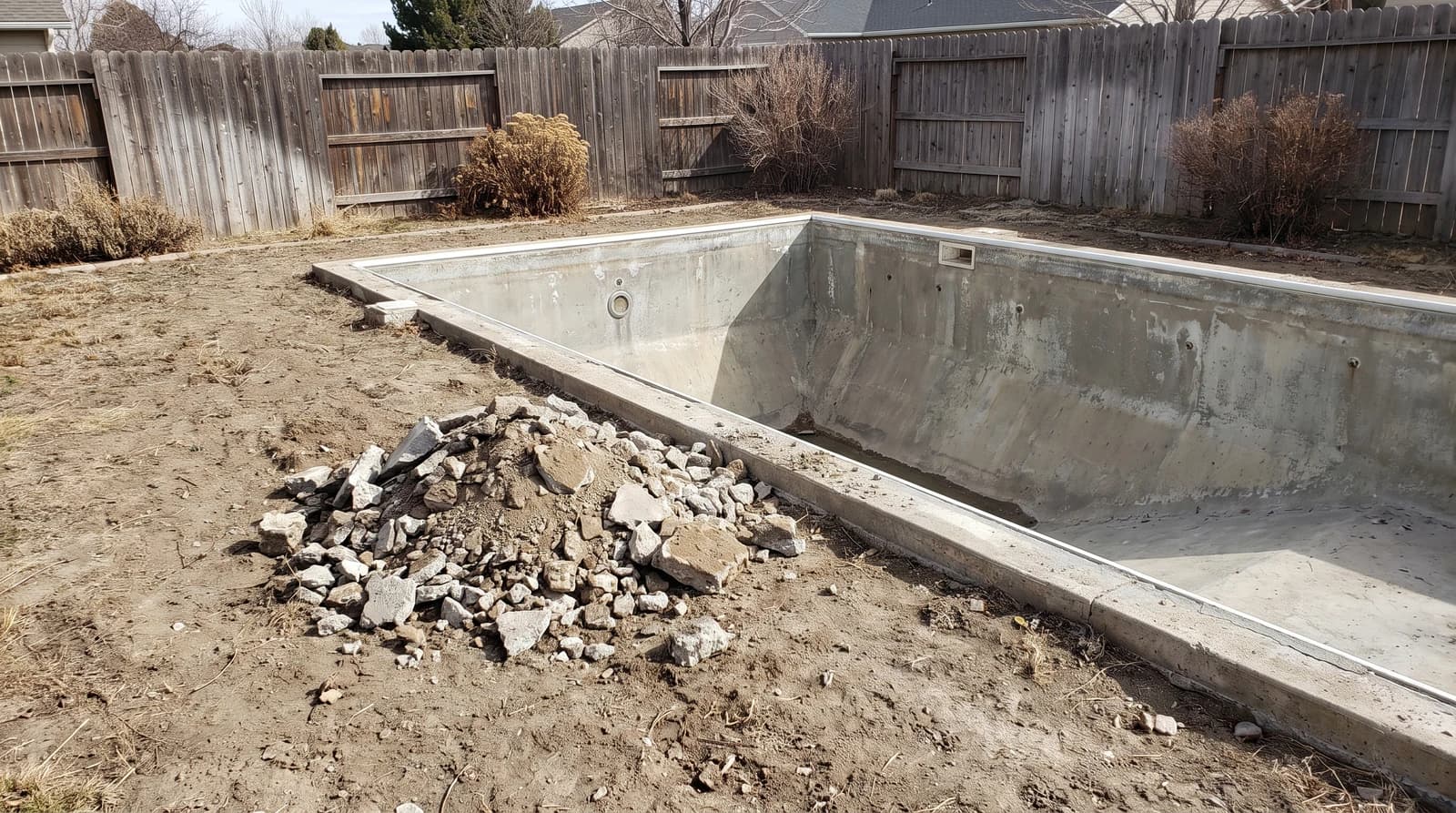

Pool Demolition in Boise: What About the Pump, Heater, and Gas?
Before pool demolition in Boise, the pump, filter, heater, gas line, and wiring need a plan. Here's what gets capped, who does it, and what's worth selling.
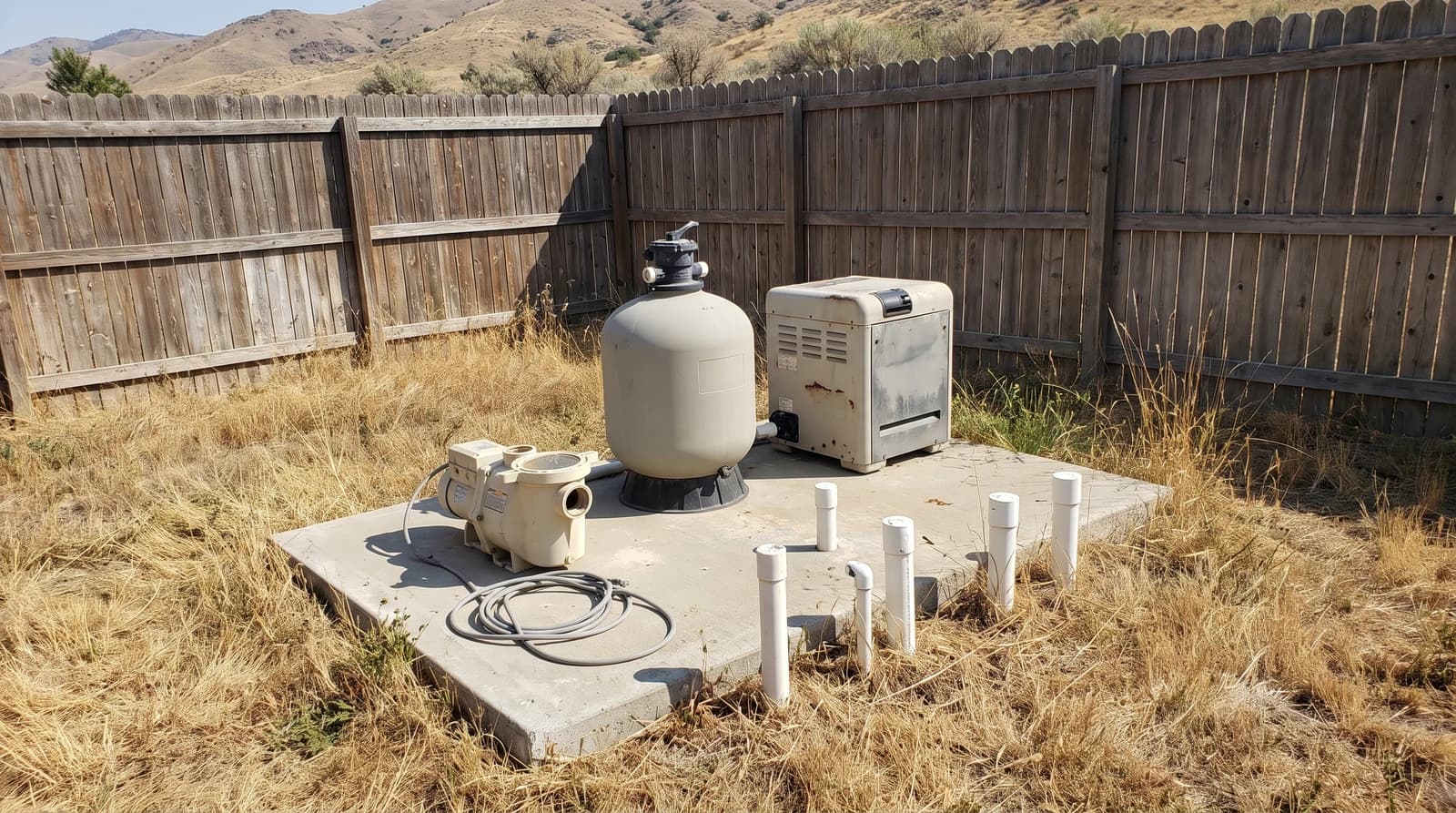
Most people planning a pool demolition in Boise think about the hole. Hardly anyone thinks about that little fenced-off corner by the side yard, where the pump hums, the filter sits, and the heater hasn't fired since 2019.
That corner matters more than you'd think. It's got live electrical, sometimes a gas line, and a few hundred pounds of metal and plastic that all have to be dealt with before we break any concrete.
Here's how it usually goes, and which parts are on you versus on us.
What's actually sitting on your equipment pad
Go take a look. Most Treasure Valley pools built in the '80s and '90s have the same basic setup: a pump and motor, a filter (sand, cartridge, or DE), maybe a heater, and a tangle of PVC tying it together.
Newer pools might add a salt cell, an automation panel, or a variable-speed pump somebody paid $1,500 for a few years back.
Then there's the stuff you can't see. A buried electrical run from the house panel. A gas line if the heater is gas-fired. Plumbing under the deck running out to the skimmers, main drain, and returns.
Each one gets handled a little differently.
Who disconnects what before pool demolition
This is where people get tripped up. They figure the demo crew will just yank it all out.
We won't touch a live circuit or an active gas line. And honestly, you don't want a crew that would.
Electrical. Pool equipment usually runs on its own 240-volt breaker, plus a separate GFCI circuit for the pool light. Flipping the breaker isn't enough when wire's getting pulled out of the ground.
A licensed electrician should disconnect it at the panel and terminate it properly. In Boise that can mean a small electrical permit, which most electricians pull for you. Figure roughly $150 to $400, depending on how far away the panel is and how messy the old wiring looks.
Gas. If you've got a gas heater, have a licensed plumber shut off and cap the line. If the work touches their side of the meter, that's Intermountain Gas.
Closing the valve at the heater doesn't count. The cap should go back where the line tees off, so you're not leaving a dead gas line under your future lawn. Around here a simple cap runs about $150 to $350.
Plumbing. This part's ours. The PVC lines get cut and either pulled out or crushed in place, depending on whether you're doing a full removal or a partial fill-in.
Still deciding between those two? Our post on when it makes sense to fill a pool in walks through it.
And yes, you still need to call 811 before demo day. Idaho's Digline marks the public utilities for free, but it needs at least two business days' notice.
Can you sell the equipment before pool demolition?
Sometimes. Newer variable-speed pumps and heaters that still fire do sell on Facebook Marketplace and KSL. Pool owners in Meridian and Nampa are always hunting for a cheap replacement pump come May.
Older stuff is a harder sell. Here's roughly how it shakes out:
| Equipment | Worth selling? | If not, where it goes |
|---|---|---|
| Variable-speed pump (under 5 years) | Usually, $200 to $500 | n/a |
| Old single-speed pump and motor | Rarely | Scrap metal (copper windings) |
| Gas heater that still works | Maybe, $100 to $400 | Scrap (copper heat exchanger) |
| Sand or cartridge filter | Hard to move | Landfill, sand gets dumped |
| Leftover chlorine, acid, shock | No | Household hazardous waste drop-off |
If you want to sell, list it a few weeks before demo and have the electrician disconnect it first. Then a buyer can just show up with a hand truck.
Whatever doesn't sell, we haul. Metal goes to scrap at places like Western Recycling, and the rest heads to the Ada County landfill with the other demo debris.
The one thing we can't toss in with everything else is pool chemicals. Half-used buckets of chlorine tabs and muriatic acid don't belong in a truck full of busted concrete.
Ada County's household hazardous waste drop-off at the landfill takes them, and last we checked it was free for county residents. Over in Nampa or Caldwell? Canyon County runs a similar program at Pickles Butte.
What stays in the ground after pool demolition
The concrete pad under the equipment usually comes out with the pool deck. It's a small slab, so it barely moves the price.
What stays buried depends on your approach. With a full removal, we dig out pretty much everything. With a partial fill-in, the plumbing lines usually get cut below grade and left in place, which is normal and totally fine.
Either way, sketch where the old lines and conduit ran and keep it with your house papers. Whoever puts in sprinklers or a fence down the road will thank you.
If you're wondering about the order of operations, here's how it goes on most of our pool demolition jobs:
- Sell whatever's worth selling.
- Electrician kills the circuit, plumber caps the gas.
- The pool gets drained (here's how to handle the water without annoying the city or your neighbors).
- Call 811 and wait for the marks.
- We show up and start breaking concrete.
Get steps two through four done ahead of time and the job moves a lot faster. Skip them, and our crew ends up standing around waiting on somebody's electrician. Nobody likes that, least of all the person paying for it.
Bottom line
The equipment pad is the most dangerous part of a pool removal, but it's also the easiest part to plan for. Get the power and gas capped by licensed pros, sell what you can, drop the chemicals at hazardous waste, and leave the rest to us.
Not sure what you've got out there or who should handle it? Yes, we'd love the job, but we're just as happy to look at a few photos of your pad and tell you what needs doing. You can check out our pool demolition service or give us a call at (208) 593-2877.
Need Help With Pool Demolition?
Top Shelf serves Boise and the Treasure Valley with professional junk removal, cleanouts, and demolition services.