
Can You Reuse Old Deck Boards? What Decking Is Worth Saving
By Eric Hinderager, owner of Top Shelf Junk Removal and Demolition · Updated
Can you reuse old deck boards? Learn which decking is worth saving, what to do with treated and composite boards, and where deck wood goes in Boise.
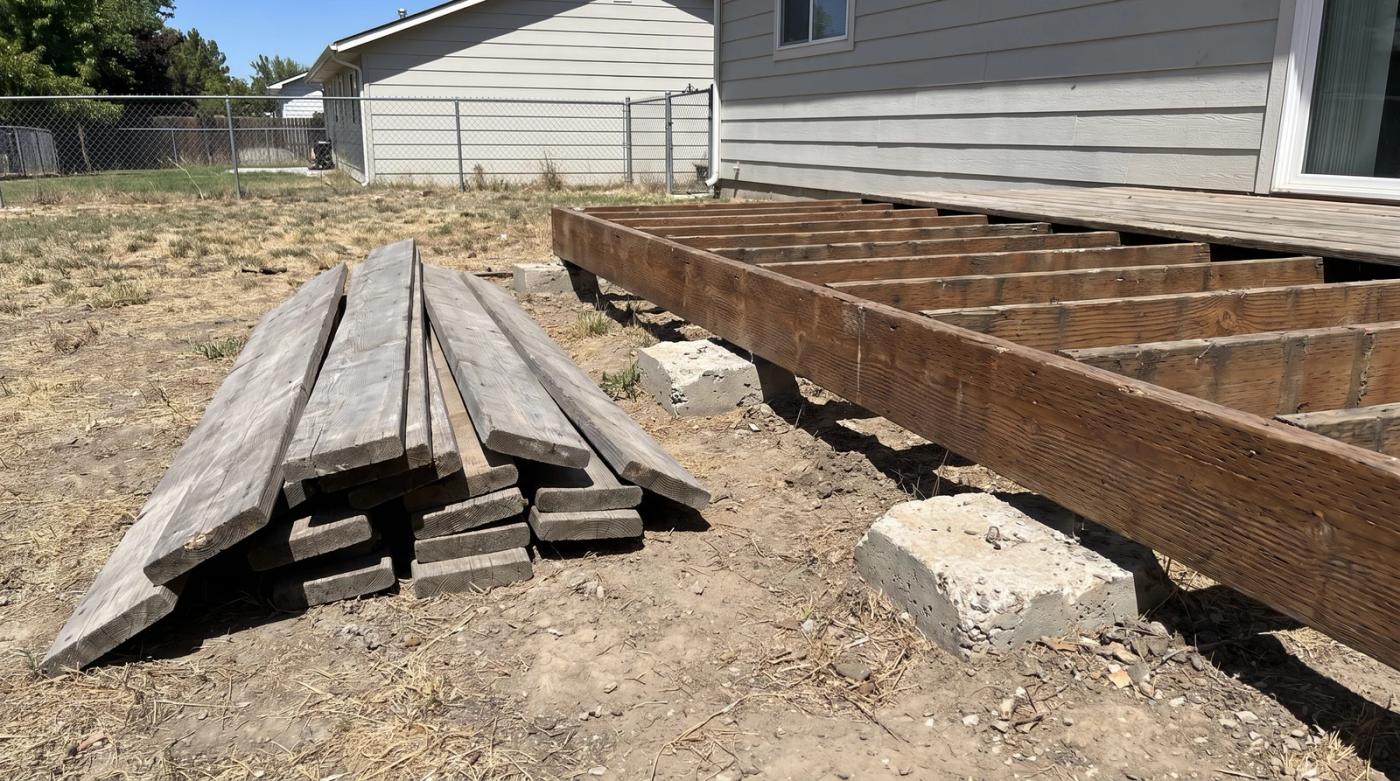
The answer to "can you reuse old deck boards" comes down to what they're made of. Untreated cedar and redwood are worth saving, and sometimes the frame underneath is too. Pressure-treated pine and composite usually aren't, with a few exceptions.
Hauling off a stack of planks that cost real money once feels wasteful. Sometimes it is. Usually it isn't.
Here's how to tell the difference before you start pulling nails.
Can you reuse old deck boards? First, figure out what they're made of
A lot of Treasure Valley decks built in the '90s and early 2000s use pressure-treated pine. Before roughly 2004, much of it was soaked in CCA, a preservative that contains arsenic. After that, the industry moved to copper-based treatments like ACQ.
Either way, that pine is full of chemicals, and that matters more than people expect.
Newer decks are more likely to be composite: Trex, TimberTech and that family of products. It's wood flour mixed with recycled plastic, and it behaves nothing like real cedar or pine when you try to reuse it.
Then there's cedar and redwood, which you'll find on some older decks around the valley. That's untreated, and it's the one category genuinely worth saving. If your surface planks are cedar, definitely don't throw them away.
Treated lumber, composite or cedar?
Not sure what you've got? A few quick checks help:
- CCA and ACQ pine often has a green or brown tint, or a tag stapled to the end.
- Cedar smells sharp when cut and has a reddish color under the gray.
- Composite looks the same all the way through, with no grain at a cut end.
Check the deck framing too. The beams and posts underneath are usually the same chemical-soaked pine, because they sit closest to the ground. The chemicals are still in there after a long time outside.
Heads up: Don't burn pressure-treated wood. Not in a fire pit, not in a wood stove, not in a burn pile out in the county. The smoke carries arsenic or copper compounds and the ash concentrates them, which is why Idaho's open burning rules don't allow it. If you can't tell what a piece is, assume it has chemicals in it.
What can you use deck wood for?
If you've got cedar, slow down before you start swinging. Old cedar is often denser and tighter-grained than what you'll buy new, and it's a good fit for repurposing into smaller projects. Gray cedar that's spent years in the weather often looks close to new after a pass through a planer.
A few common ways to put salvaged deck lumber to work:
- Cedar planks planed down into fence pickets or shop shelving
- Untreated 2x8 and 2x10 joists reused as garden bed frames or workbench tops
- Cedar posts cut down into planter boxes
- Handrail sections turned into a trellis, which sounds odd but looks good
- Short offcuts turned into outdoor benches, step stools or a potting table
The trick to repurposing is picking a design that suits worn material. Nail holes, old stain and a weathered face look fine on a rustic planter. They don't look fine on a dining table. Lumber boards with soft spots or deep splits aren't worth saving for anything.
Before any salvaged cedar goes through a planer or saw, pull every nail and screw. A buried screw chips the blades fast, and a handheld metal detector wand makes the hunt quicker.
The pressure-treated pieces still have some uses, as long as nothing edible grows in them and nobody burns the scraps. Think sawhorses, a shed floor, or a small porch step that'll sit outside anyway. For anything that holds weight, check for rot first.
What doesn't work is raised vegetable beds out of treated lumber. The copper leaching risk is low with modern ACQ, but with older CCA pine you're putting arsenic next to the tomatoes. Not a trade we'd make.
Repurposing the plastic-blend stuff is harder. Solid pieces of composite can be cut into small outdoor step pads, but it doesn't plane, sand or glue the way cedar does.
And don't count on donating it. Thrift stores like Idaho Youth Ranch generally take furniture and household goods, not used building material full of nail holes.
Where do deck materials go for recycling or disposal?
On a typical tear-out we're separating material as we go, not after. It's faster that way and it keeps the disposal cost down. Here's roughly where everything ends up.
| Material | Where it usually goes | Worth salvaging? |
|---|---|---|
| CCA or ACQ pine | Hidden Hollow Landfill | No |
| Composite decking | Landfill (rarely recyclable locally) | No |
| Cedar or redwood | Reuse, resale, or milling | Often yes |
| Beams and posts | Landfill, unless the frame stays for a new deck | Sometimes |
| Joist hangers, screws, flashing | A scrap metal recycler | Yes, but low value |
| Concrete footings | Concrete recycler or landfill | No |
The metal is the part people forget. Even a modest deck has a surprising amount of galvanized hardware in it, plus whatever ledger flashing was tucked against the house. It won't pay for your job, but it keeps that metal out of the landfill, and pulling it aside doesn't add much time.
Trex-style decking is the frustrating one. It comes off clean, it's often still structurally fine, and there's basically no local outlet for used pieces. Some manufacturers have run take-back programs, so check with yours, but don't count on it.
Your location in the valley changes where the rest goes. Ada County's landfill is Hidden Hollow, and Canyon County runs its own at Pickles Butte. Each location sets its own rules and fees, so check before you haul any deck lumber yourself.
Cedar is the exception. If those leftover deck boards are cedar or redwood, definitely don't throw them away. List them locally or offer them to a friend with a woodshop.
Leftover decking that was never installed is a different story. Clean, unused decking material is easy to give away, and the store that sold it may take returns.
Does saving wood lower your deck removal cost?
A little. Not as much as you'd hope.
Most of what drives the price on a deck removal job is the work involved and how much truck space the debris takes up. Around Boise, Meridian, and Nampa, the cost comes down to the deck's size, how high it sits off the ground, how it was put together, and how the footings were set.
Pull a stack of cedar out of that and you might shave a bit off the disposal side. You're not cutting the bill in half.
Keeping the existing framing changes the job more than saving the surface does. If the frame stays, the crew strips only the top layer and works around what's left, so decide that before the walkthrough.
Where it does help: stack and set aside the cedar you want before we show up, so it isn't mixed in with everything else. Tell us at the walkthrough which pieces you're keeping and we'll work around them.
Yes, we'd love the whole job. But if you've got good cedar and a real use for it, keep it. We'd rather you get something out of it than watch it ride to Hidden Hollow.
One more thing worth checking first: is the deck coming off clean, or coming off the house? If it's ledger-attached, the siding and flashing underneath can turn into their own project.
Good to know: If you're planning a new build in the same spot, say so at the estimate. It affects whether the footings and frame come out or stay.
Bottom line
Cedar and redwood, save it. Pressure-treated pine and composite, let it go, and don't burn the pine. The scrap metal is worth separating even though the payout is small.
If you want someone to tell you straight what's salvageable, Top Shelf Junk Removal and Demolition can look at that during a deck removal estimate, and the estimate is free. Call or text and we'll come take a look.
Frequently asked questions
What is the 3/4/5 rule for decks?
It's a quick way to check that deck framing is square. Measure 3 feet along one side from a corner and 4 feet along the other, and the diagonal between those marks should be 5 feet. Do it before you build new decking onto an old frame.
When is it time to replace a deck plank?
When it's soft, cracked deep, badly cupped or won't hold a screw. Push a screwdriver into a suspect spot, and if it sinks in easily, there's rot. Pay attention to location, since pieces near the house, under a downspout or by the steps usually go first.
Can you flip the planks over and reuse them?
Sometimes, with cedar or pine. After years of sun, the underside can be in better shape than the top, but it's often cupped or stained and full of old screw holes. A lot of composite has only one finished face, so flipping it rarely works.
Can you build a new deck on the existing frame?
Related reading: Removing a Deck From a House: Where All That Lumber Ends Up and Concrete Slab Demolition: Can You DIY It, or Should You Hand It Off?.
Sometimes. The frame has to be solid after years of weather, especially where it meets the ledger. Composite decking often needs tighter joist spacing than wood, so check the install guide, and ask your city's building department whether a change to the deck design needs a permit.
Need Help With Deck Removal?
Top Shelf serves Boise and the Treasure Valley with professional junk removal, cleanouts, and demolition services.